
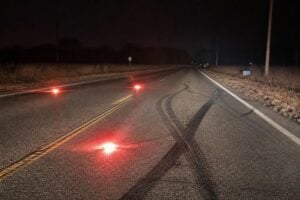
Intoxication manslaughter is usually a DWI crash in which someone died, though the law also covers boats, planes and amusement rides. It’s a second-degree felony with 2 to 20 years in prison and up to a $10,000 fine (Penal Code §§ 49.08, 12.33), and it becomes a first-degree felony, 5 to 99 years or life, when the person killed was an on-duty peace officer, judge, firefighter or EMS worker, or, for crashes on or after September 1, 2025, when more than one person died (§ 49.09(b-2), as amended by SB 745). The State doesn’t have to prove you meant to hurt anyone (§ 49.11(a)). It does have to prove you were intoxicated, and that the death happened because of that intoxication. That second part is where many of these cases are fought.
Call (713) 664-4000. If you’ve been released or haven’t been charged yet, don’t talk to investigators or anyone from the other family’s side before you talk to us.
Intoxication manslaughter is the most serious case our Houston DWI lawyer practice handles, and we start on the blood evidence and the crash reconstruction the day we’re hired.
What makes these cases so serious
| Issue | What the law says |
|---|---|
| Deferred adjudication | Not available (Code of Criminal Procedure Art. 42A.102(b)(1)(A)) |
| Probation | Possible on a sentence of 10 years or less, but at least 120 days of confinement is a mandatory condition, even on jury-recommended probation (Art. 42A.401(a)(5)) |
| Deadly weapon finding | Almost always requested. It takes probation away from the judge, leaving only a jury recommendation for someone with no prior felony, and means serving at least half of a prison sentence before parole eligibility (Art. 42A.054(b); Gov’t Code § 508.145(d)) |
| More than one death | Each death can be a separate count, and the sentences can be stacked (Penal Code § 3.03(b)(1)) |
| Restitution for the victim’s children | The court must order monthly support for a child whose parent or guardian died, until the child turns 18 or graduates from high school, whichever is later, but never past age 19 (Code of Criminal Procedure Art. 42.0375) |
The Legislature passed two different 2025 versions of the first-degree provision. SB 745 added crashes where more than one person died. HB 2017 instead added drivers who have a prior intoxication conviction and were in violation of the state’s illegal-entry law (Penal Code chapter 51) at the time. Texas law says conflicting amendments from the same session are read together when possible (Gov’t Code § 311.025(b)), and how that plays out in your case is one of the first things we sort out.
Causation
The statute requires that the death happen “by reason of that intoxication.” If the other driver ran the light or pulled out without looking, the crash may have happened the same way with a completely sober driver. The State will argue that a sober driver would have avoided it. But under Penal Code § 6.04(a), you’re not criminally responsible when another cause was clearly enough to produce the result and your conduct was clearly insufficient. Proving that takes crash reconstruction, the vehicles’ event data recorders, the scene measurements and any video, gathered early, before the vehicles are repaired or destroyed.
The blood evidence
After a fatal crash, police almost always get the driver’s blood. Texas law requires a specimen after an arrest and refusal in a crash involving death, but it doesn’t let officers skip the warrant. The Court of Criminal Appeals held that the mandatory blood draw statute doesn’t justify a warrantless draw on its own (State v. Villarreal, 475 S.W.3d 784 (Tex. Crim. App. 2014)), and the statute itself now requires a warrant or real exigent circumstances (Transportation Code § 724.012(e)). When there’s a warrant, we look at the affidavit, the draw, the timing and the lab work. Jay Blass Cohen is an ACS-CHAL Forensic Lawyer-Scientist trained in forensic chromatography and a certified Drug Recognition Expert. In a case that turns on a blood result or a drug recognition evaluation, that training is the difference between accepting the State’s numbers and taking them apart.
How we handle an intoxication manslaughter case
We move on the physical evidence first, because it’s the first thing to disappear. We send preservation letters for the vehicles, their event data, nearby video and the 911 recordings, and we bring in our own reconstruction expert when the facts call for one. We get the complete medical examiner’s file, including the other driver’s toxicology when it’s there. And we prepare the case for trial, because with no deferred adjudication available and a prison range on the table, the pressure in negotiations comes from being ready to try it. For a crash with serious injuries and no death, see our page on intoxication assault.
Charged with intoxication manslaughter in Houston? Call Blass Law
Jay Blass Cohen has defended DWI and intoxication cases in Houston since 2009 and has never worked for the prosecution. We know these cases are tragedies for everyone involved, and we treat them that way while we fight the charge.
Call (713) 664-4000. If the crash just happened, call today. The vehicles and the data inside them won’t be there for long.
Reviewed by Jay Blass Cohen, founder of Blass Law PLLC, ACS-CHAL Forensic Lawyer-Scientist, certified Drug Recognition Expert, and SFST instructor, serving Houston since 2009. This article is general information, not legal advice for your situation. Prior results do not guarantee a similar outcome.